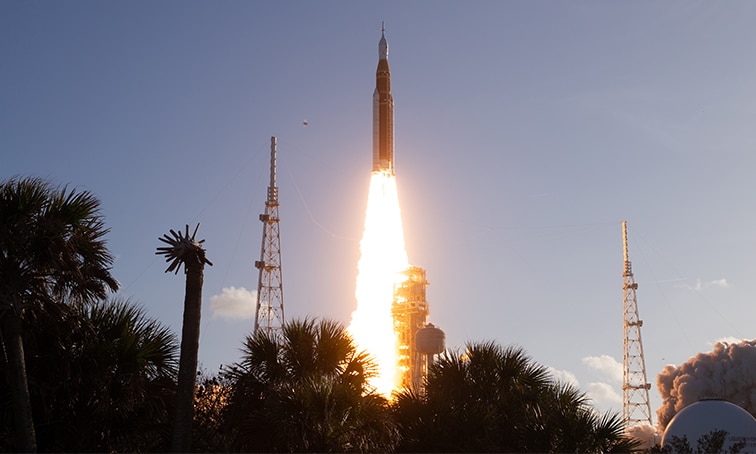
The rocket carrying the Orion spacecraft with NASA astronauts Reid Wiseman, Victor Glover, Christina Koch and CSA (Canadian Space Agency) astronaut Jeremy Hansen, mission specialist onboard launches on the Artemis II mission, on Wednesday, April 1 from NASA’s Kennedy Space Center in Florida. (NASA/Aubrey Gemignani)
Courtesy NASA
For the first time in more than 50 years, astronauts on a NASA mission are bound to fly around the moon after successfully completing a key burn of Orion’s main engine.
With the approximately six-minute firing of the spacecraft’s service module engine on Thursday, known as the translunar injection burn, Orion and its crew of NASA astronauts Reid Wiseman, Victor Glover, Christina Koch, and CSA (Canadian Space Agency) astronaut Jeremy Hansen accelerated to break free of Earth’s orbit and began the outbound trajectory toward the moon.
“Today, for the first time since Apollo 17 in 1972, humans have departed Earth orbit. Reid, Victor, Christina, and Jeremy now are on a precise trajectory toward the Moon. Orion is operating with crew for the first time in space, and we are gathering critical data, and learning from each step,” said Dr. Lori Glaze, acting associate administrator for the Exploration Systems Development Mission Directorate at NASA headquarters in Washington. “Each milestone we reach marks meaningful progress on the path forward for the Artemis program. While we have eight intensive days of work ahead, this is a big moment, and we’re proud to share it with the world.”
Orion’s main engine provides up to 6,000 pounds of thrust, enough to accelerate a car from 0 to 60 mph in about 2.7 seconds. At the time of the burn, Orion’s mass was 58,000 pounds and burned approximately 1,000 pounds of fuel during the firing.
Artemis II crew members also are spending time exercising on the spacecraft’s flywheel exercise device. During exercise, teams on the ground monitored the spacecraft’s air revitalization system, which maintains a breathable, comfortable cabin environment for the crew, and assessed how exercise impacts movement of the spacecraft.
The flywheel uses a simple cable‑based mechanism that supports both aerobic exercises like rowing and resistive movements such as squats and deadlifts.
Operating much like a yo‑yo, the device provides resistance proportional to the force applied, allowing loads up to 400 pounds. This capability is especially important in deep space, where astronauts do not have access to the extensive exercise equipment aboard the International Space Station.
Follow the latest mission progress, including more images from the test flight, at:
https://www.nasa.gov/artemis-ii
x





Pro baseball
Yard Goats earn spot in Eastern League playoffs


UConn football
Playing with speed, Maryland wears out Huskies in 38-14 win